Most organizations struggle with strategic alignment because they conflate financial targets with a coherent strategy. In practice, leadership often presents a handful of high-level board metrics alongside an uncoordinated backlog of tactical projects. Individual contributors see the projects on their sprint boards and hear the revenue targets in all-hands meetings, but have no clear model connecting the two.
An effective strategic framework solves one fundamental problem: it gives everyone in the organization a shared model to explain how their daily work directly advances the company mission. Achieving this clarity requires connecting three distinct tiers: the Mission, the Strategy, and the Work.
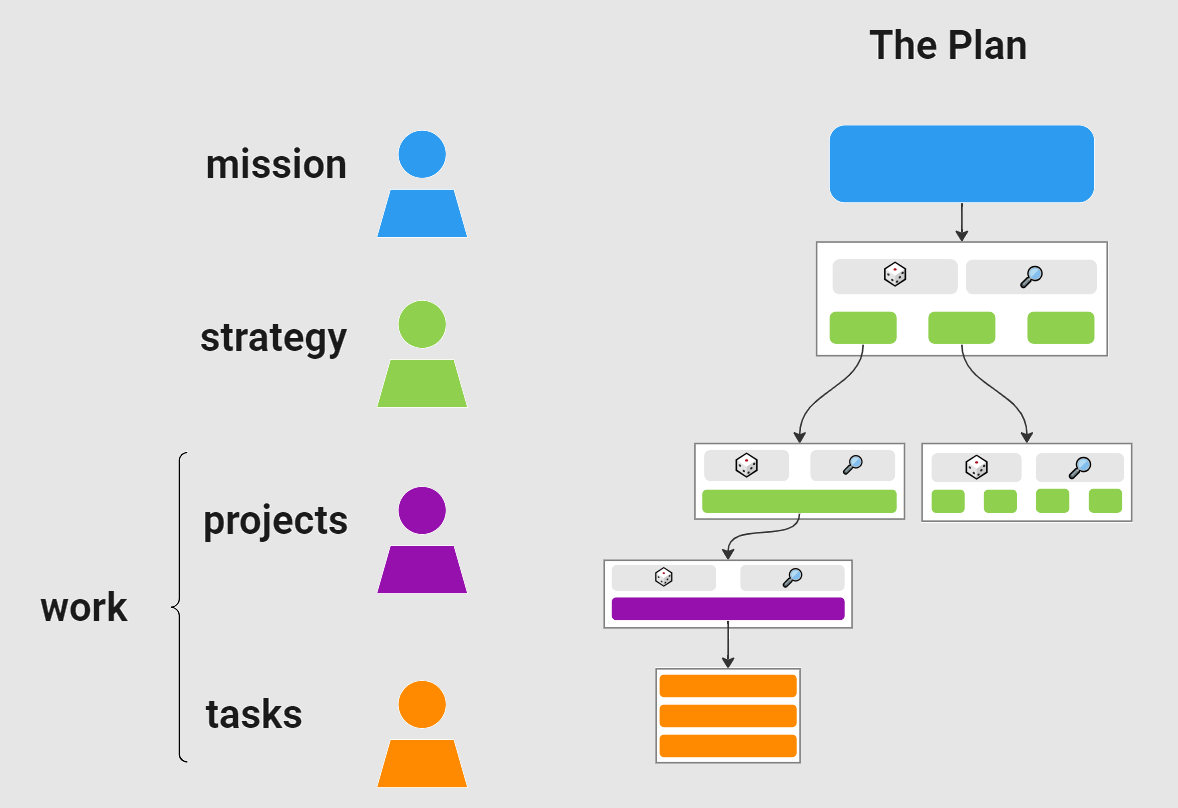
The three tiers of the framework
The overall plan consists of three interdependent layers:
- The Mission. A single, enduring statement of organizational purpose.
- The Strategy. One or more layers of structured strategy statements that define the hypotheses and bets required to achieve the mission.
- The Work. The discrete projects, features, and tasks undertaken to execute the strategy.
The Mission: Setting the destination
The mission statement defines the ultimate reason the organization exists. It sits at an ambitious scale, establishing a clear long-term destination without prescribing the mechanical steps needed to reach it.
While every subsequent layer of planning requires evidence and justification, the mission is unique. It serves as the foundational premise of the company, acting as the starting point from which all downstream decisions flow.
The Strategy: Defining hypotheses and bets
Strategy bridges the gap between high-level ambition and daily execution. Rather than representing self-evident truths, strategy statements are structured bets made under conditions of uncertainty.
Every complete strategy statement contains three core elements:
- The parent goal. The higher-level objective it supports, which is either the top-level mission or a parent strategy goal from the tier above.
- Prioritized sub-goals. A focused collection of smaller objectives that support the parent goal.
- A causal rationale. An explicit argument explaining why achieving the sub-goals will produce the parent outcome (for example: “We believe that improving onboarding speed will increase retention, because early user activation strongly correlates with renewal rates”).
Clear accountability is essential at this layer. Every sub-goal requires a single responsible owner. When a team owns multiple sub-goals, leadership must establish strict relative priorities; without clear ordering, teams struggle to make principled tradeoffs when resource constraints arise.
The Work: Executing bounded deliverables
The work encompasses the concrete projects and operational initiatives an organization undertakes to advance its strategic goals. This includes engineering tasks like refactoring an authentication service, commercial efforts like acquiring enterprise accounts, or marketing campaigns designed to increase product trial signups. While strategy statements define prioritized outcomes under uncertainty, the work consists of bounded, tangible deliverables.
Calibrating the strategy-to-work boundary
The point where strategy statements give way to concrete tasks represents the boundary of delegated strategic ownership. Organizations structure this boundary at different depths based on team maturity and operating environment:
- Shallow strategy (Centralized ownership). Strategy statements are formulated at the executive and departmental levels, after which teams receive direct project assignments. This model functions effectively when domain knowledge is concentrated in leadership, when operating in stable markets, or when teams need clear operational guardrails.
- Deep strategy (Distributed ownership). The process of translating broad objectives into localized strategy statements extends directly to individual product teams (such as well-implemented Objectives and Key Results, or OKRs). This approach thrives in rapidly evolving domains where specialized teams closest to the customer hold the best context to determine how goals should be met.
Distributing strategic ownership requires that teams possess deep domain context and high alignment. When an organization lacks those preconditions, attempting to enforce deep strategy can create confusion and misaligned execution. A clear, well-communicated shallow strategy consistently outperforms an overly complex distributed model that the organization cannot yet support.
In Part 2, we will walk through a concrete example of this framework applied to a growing enterprise product.